Studying Geometry in another way
Target: To know, interpret and spread some of the propositions of the most famous geometry book of the mankind, the Euclid’s Elements
Tourist route: Machado de Castro National Museum (Coimbra) - Physical laboratory of the XVIII and XIX century (University of Coimbra) - Joanina Library (University of Coimbra)
The mathematical community always had didactic concerns looking for stimulating, in diverse forms and searching for diverse materials, the mathematical learning.
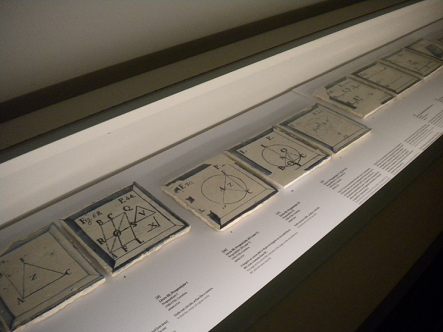
The collection of tiles present at the Machado de Castro National Museum is a proof of this commitment and effort. As far as we know is unique. These tiles faithfully reproduce geometric diagrams of some propositions of the Euclid’s Elements with a didactic and scientific concern, more than aesthetic, witnessing pedagogical practices of centuries ago.
One of the principal merits of the Elements is to present a very considerable part of the knowledge mathematically obtained until that date, according to a deductive and unified organization: axiomatic, as it is said nowadays.
The organization of the Elements was framed in the Aristotelian conception. According to this conception a demonstrative science should be based on a set of first principles of the theory: definitions, common notions or axioms and postulates. Hence all other propositions derive from the deductive way, observing the laws of the syllogism.
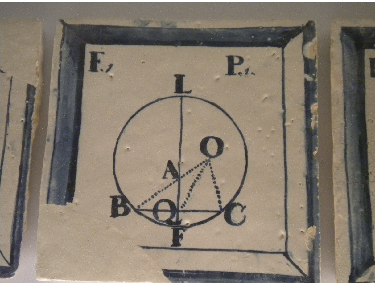
Elements III,1:To find the centre of a given circle
In the circle is drawn any line BC and cut through the middle in Q. By Q draw the perpendicular LF and cut through the middle in A. A is the centre to be found. In fact, if the centre is in LF, it can not be other than A, since any other point of this line divides it into two unequal parts.
If it is outside LF, for example at O, the lines OB, OQ and OC are drawn. The triangles BOQ and COQ have all sides respectively the same (since OB and OC are radii of the circle, QB and QC are equal by construction and QO is common), so the angles OQB and OQC are equal and therefore right. However, the angles LQB and LQC (by construction) are also straight; So straight ones are bigger than others, which is absurd.