Geometric shapes in defensive structures
Target: to know the geometry of the areas and the square of the circle problem
Tourist route: Stronghold of Almeida (centre of Portugal) - Stronghold of Elvas (south of Portugal) - Stronghold of Valença (north of Portugal)
The construction of military fortifications is related to the need for defense and protection of territories and villages. From Renaissance, Mathematics, in particular Geometry, plays an important role in the process of changing military architecture, as well as in the development of military knowledge itself.
This change in fortification systems was associated with the invention of the press by Gutenberg, whichallowed the circulation of books in another way, as was the case with the Euclid’s Elements; the invention and development of drawing techniques, and the rediscovery of Plato's philosophy that introduces geometric forms into architecture. Also the development of artillery boosted the design of fortifications with angular and no more circular bulwarks. We are faced with a new form and ways of fortifying that are based on the use of geometry by methods of constructing regular polygonal figures.
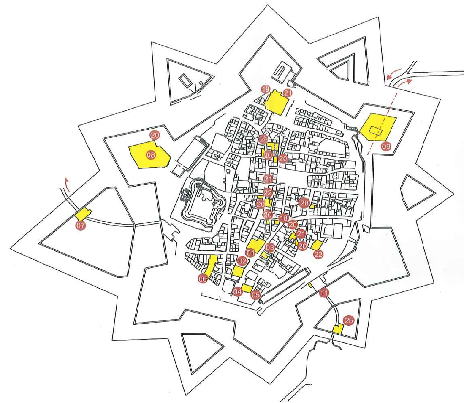
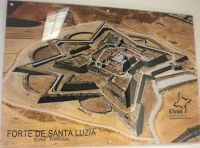
Portugal has three strongholds that present these characteristics: polygonal shape with angular bulwarks. The stronghold of Almeida, Elvas and Valença. Although the stronghold of Valença has a sophisticated plan and the stronghold of Elvas is called the "Queen of the Border" because together with Graça and Santa Luzia Forts, is one of the largest groups of fortified Forts in the world, with a perimeter of more than 10 kilometers, the stronghold of Almeida, with a hexagonal shape, is considered the most monumental of the Portugal strongholds.
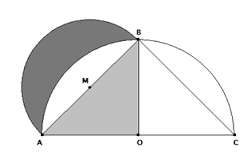
But the interest in polygonal figures is also present in the history of Mathematics. In the fifth century BC, the Geometry of the areas related to polygonal figures dominated mathematical investigation, in particular its extension to curvilinear figures. The problem was to build the side of a square with an area equal to a given circle, with a ruler and compass. Today, it is known that it is impossible to do that only with those instruments, but Hippocrates of Chios, in the fifth century, BC managed to square certain curvilinear figures designated by lunules, a flat figure delimited by two arcs of circumference with the concavity in the same direction.